Amr Ayman

Software Engineering & Technology Articles
🕑 8 mins
As software systems grow, code can become hard to understand, scale, and maintain. That’s why SOLID principles is needed.
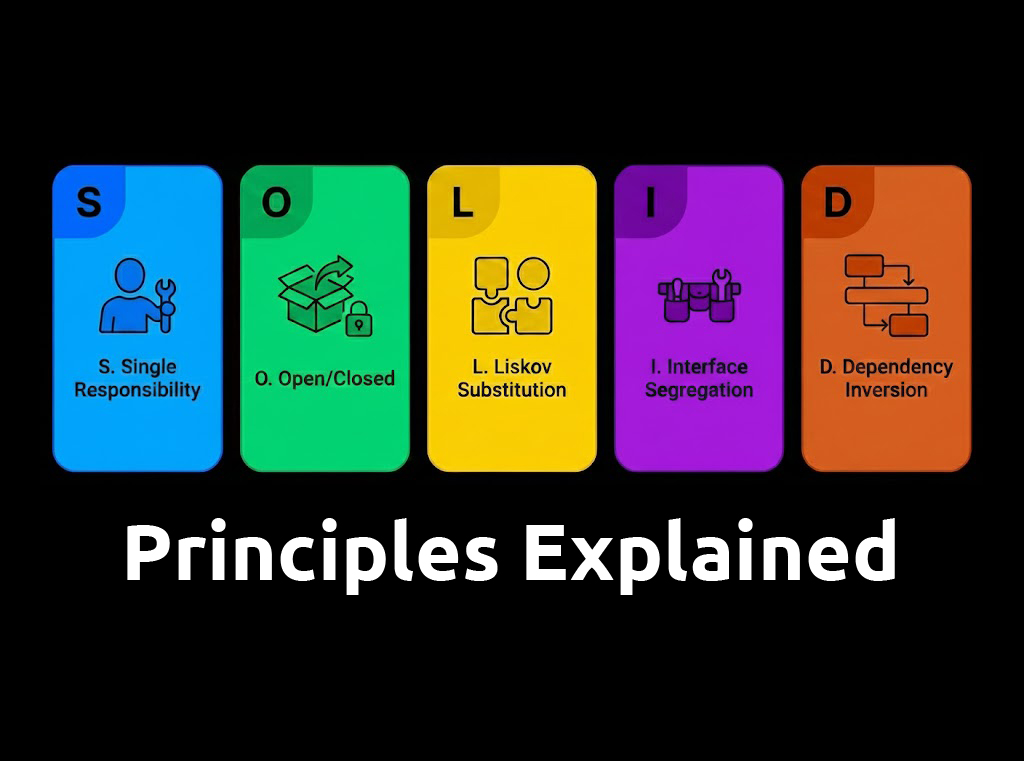
SOLID is a set of five object-oriented design principles introduced by Robert C. Martin (Uncle Bob) that help developers build scalable, readable, and maintainable software projects.
Let’s Get into each point !
Each class should have one responsibility, not multiple unrelated tasks.
Bad Practice:
This class manages User and Emails.
public class UserManager {
    public void saveUser(User user) {
        // save user to database
    }

    public void sendEmail(User user) {
        // send email
    }
}Good Practice:
public class UserRepository {
    public void saveUser(User user) {
        // save user
    }
}

public class EmailService {
    public void sendEmail(User user) {
        // send email
    }
}Classes should be open for extension but closed for modification. So adding new behavior should be done without changing the existing code.
Bad Practice:
Adding a new payment method requires modifying this class.
public class PaymentService {
    public void pay(String type) {
        if (type.equals("CARD")) {
            // card payment
        } else if (type.equals("CASH")) {
            // cash payment
        }
    }
}Good Practice:
public interface Payment {
    void pay();
}

public class CardPayment implements Payment {
    @Override
    public void pay() {
        // card payment logic
    }
}

public class CashPayment implements Payment {
    @Override
    public void pay() {
        // cash payment logic
    }
}Objects of a parent class can be replaced by its children without breaking functionality.
Bad Practice:
not all birds can fly.
public class Bird {
    public void fly() {
        // fly logic
    }
}

public class Penguin extends Bird {
    @Override
    public void fly() {
        throw new UnsupportedOperationException("Penguins can't fly");
    }
}Good Practice:
public interface Bird {
}

public interface FlyingBird extends Bird {
    void fly();
}

public class Sparrow implements FlyingBird {
    @Override
    public void fly() {
        // flying
    }
}

public class Penguin implements Bird {
}Clients should not depend on interfaces they do not use.
Bad Practice:
Robots don’t eat, but they are forced to implement eat().
public interface Worker {
    void work();
    void eat();
}

public class HumanWorker implements Worker {
    public void work() {}
    public void eat() {}
}

public class RobotWorker implements Worker {
    public void work() {}
    public void eat() {}
}Good Practice:
public interface Workable {
    void work();
}

public interface Eatable {
    void eat();
}

public class HumanWorker implements Workable, Eatable {
    public void work() {}
    public void eat() {}
}

public class RobotWorker implements Workable {
    public void work() {}
}High-level modules should depend on abstractions, not concrete implementations.
Bad Practice:
public class OrderService {
    private MySqlDatabase database = new MySqlDatabase();
}Good Practice:
public interface Database {
    void save();
}

public class MySqlDatabase implements Database {
    @Override
    public void save() {
        // save to MySQL
    }
}

public class OrderService {
    private final Database database;

    public OrderService(Database database) {
        this.database = database;
    }
}Always Write code that is easy to understand, test, and extend, and follow SOLID to achieve that!
Share
Rate This